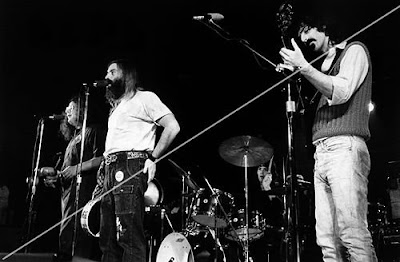
Bob Dylan’s Electric Factory Show Sure Did Stink!


We couldn’t have been more thrilled to attend Bob Dylan’s “Electric Factory” concert in Philly on August 8th, 2008. We had feelings of the old “Fillmores” — (East and West): as this is one of those places reminiscent of yesteryear where there are no seats in front of the stage, only standing room. That means if you get there early enough, you’d have a chance for front-row center, no matter who you are and how late you got your tickets. The “Electric Factory” has some unique history; the original "Electric Factory" venue was a converted tire warehouse at 22nd and Arch Streets, which opened in 1968 and closed in 1973. The first performers, on February 2, 1968, were the Chambers Brothers. The building was torn down and replaced with condominiums. The "Electric Factory" was resurrected circa late 1994 or early 1995 and now stands at the current site (located at 421 N. 7th Street between Willow and Spring Garden Streets).
Some of the caveats we faced by armchair critics on the Web were that the sound system is lousy, the staff is rude and to “beware” of the folks flagging you down to park in lots that do not belong to the “Electric Factory” and can be several blocks away. But armed with this helpful knowledge, we were prepared for what we might experience.
Not only did we wind up with a spot right in front of Dylan with only the folks who got to the stage’s rail obstructing our view, and aside from being ‘in the know’ and getting the right parking spot, we didn’t encounter any other problems. The sound was lousy, but not unforgivable — it was hot as a sauna, but look at the Cavern Club where the Beatles first played; who can complain? There was one big problem though — even as Dylan and the band put on a great show, the “Electric Factory” show did stink. Flatulence, back door trumpets, wind, someone ‘cutting the cheese’, gas, farts, stink bombs!! Ladies and gentlemen, there was somebody very near us, and I pray it was a man, who stunk up our spot something awful. To overcome the heat alone, I decided to use my Tai Chi breathing, deep intakes of air to the diaphragm, but every time the offender released one of ‘his’ grenades, it was awful. It stunk of the drunken bum variety — if you know what I mean — pure rot folks. What a stink!
But what about the show? Did Dylan stink? Heck no! He was sublime! Watching him turn his classic songs around into update versions was a learning experience only few can appreciate. Having the liberty to be so close to him was a one-in-a-lifetime experience to be treasured.

The set list for the evening included:
Cat's In The Well (Under The Red Sky)
Lay Lady Lay (Nashville Skyline)
The Levee's Gonna Break (Modern Times)
Moonlight (Love and Theft)
Tangled Up In Blue (Blood On The Tracks)
Things Have Changed (Wonder Boys: Music From The Motion Picture)
Spirit On The Water (Modern Times)
Honest With Me (Love and Theft)
Beyond The Horizon (Modern Times)
It's Alright, Ma (I'm Only Bleeding) (Bringing It All Back Home)
Trying To Get To Heaven (Time Out Of Mind)
Highway 61 Revisited (Highway 61 Revisited)
Nettie Moore (Modern Times)
Summer Days (Love and Theft)
Ballad Of A Thin Man (Highway 61 Revisited)

The encore included two songs that would have made appropriate, if not better, titles for this very article: Thunder On The Mountain (Modern Times) and Blowin' In The Wind (The Freewheelin’ Bob Dylan).

Interesting asides include that the band used Buddy Guy’s soulful rendering of Lay Lady Lay behind Dylan’s updated vocals. Dylan used the phrase, “You can eat your cake and have it too” in place of “You can have your cake and eat it too” in the aforementioned song. He also grinned to himself many times as he altered song lyrics and allowed us to experience what he is known for. Plus we caught him doing a few deep knee bends and stretches in between tunes, perhaps a form of Dylan Tai Chi for the wishful thinking of an East Meets West style blogger. I wish I knew where he got his hats from, I'd love to get one like it!
Mr. Dylan, we wish you well and thank you for a great show! In more ways than one, it was truly a gas.
Philly Show Photo Courtesy of Zack Shapiro and ShutUpInternet.com

Dark Knight: A Slight Blur


I went to see Dark Knight and wouldn't you know it, I forgot my glasses. Don't you hate when that happens?

Thank You Very Much!


One of my very special readers gifted me John & Yoko's album, Sometime In New York City!! Here's a photo of it on my iTunes. Now if you've been reading this blog, you'll know why. If not, read on!!!
謝謝您

Ringo Starr & Levon Helm!


Two of the greatest drummers in Rock and Roll History and also two of the nicest guys in the entertainment world! From RingoStarr.com, a behind-the-scenes look at Ringo & Levon in NYC!!!
Peace & Love!

Let It Be Released!
(An Open Letter To Paul McCartney & Ringo Starr)


Dear Paul & Ringo,

How could you? You've gone too far! How could you deprive us, your loyal fans - many of who have been waiting years with baited breath - for the release of your masterpiece film Let It Be?
Sure there is bickering in the film, but that's what makes it great. It shows us fans that the Beatles were people too! Just like the Anthology series showed us the Beatles making mistakes, goofing up lyrics and so on, Let It Be tells us that nobody is perfect and even the Beatles had arguments. It's a healthy thing for us to see. Would you want us to think that the Beatles were flawless and that we can never be like them? What happened to your spirituality? I don't believe that John and George would ever make this decision.
Aside from the few times that there was arguing in the film, for example Paul: George telling you that he'll play whatever it is you want him to play, or he won't play at all - “Whatever it is that would please you” - there are also glorious moments in the film. These are life-lessons that we can all benefit by. Or again, when George brought in the late, great Billy Preston to help raise everyone's spirits by bringing a non-Beatle in to perform with. Finally, the concert on the rooftop; it's a masterpiece — the last time we get to enjoy the Beatles playing together live! How can you not release it?
The thought of holding back the release of Let It Be is almost as sad as the thought of another death in the Beatle family. We've already lost Brian, Mal, John, Linda, Maureen, George, Neil and many others. Please, do not make us lose a cherished film like Let It Be.

Sincerely Yours,

Master Zhihui
July, 31, 2008

PS: We still love you!

Giving the Gift of Dylan...


Happy Birthday!

The Beatles: The Mothers


"So Sergeant Pepper took you by surprise.." Read more...

Quote of the Day: Yoko Ono

John & Yoko with Frank Zappa and the Mothers of Invention, Live at the Fillmore East, 1971


The video quality is bad, but the music is great! Here is the unedited versions of "Well (Baby Please Don't Go)", "JamRag", "S---bag" and "Au".
Check it out and then read our interview with Howard "Eddie" Kaylan where he reminisces about that night and how he put Yoko in the bag.
Kaylan opines, "And what he did with it was he took the white, penciled Cal Schenkel text from the Fillmore album and Yoko just annotated it to her liking in red magic marker. So when it came to my description for instance, she scratched out the word ‘lead’ and just left vocals. When it came time to list instrumental songs that John really didn’t know, John made up titles. He had the unmitigated gall to call one of Frank’s classic songs — “King Kong” I believe, one of his all-time biggest instrumentals — Lennon didn’t know what it was, called it “Jamrag” then said that he wrote it!"
But what he doesn't take into consideration is that perhaps it was just a joke that nobody got -- years earlier Zappa parodied the "Sergeant Pepper" album with "We're Only In It For The Money". So John and Yoko did the same with the "Live At The Fillmore" album... get it?
This was done plenty of times before between the Beatles themselves. They would often reference, parody and sometimes play homage to each other in their albums. Lennon poked fun of McCartney's album cover Ram, when he took the same pose, this time holding a pig. I'm sure no offense was meant in the Lennon/Ono release of the live Zappa concert. But to hear and see it as it was, without any outside influences clouding one's memory, simply click above while it lasts!

Jade Wah, Sweet and Sour Pork, and The Wisdom Of The Chinese Kitchen Part II


There used to be a very nice Chinese restaurant in the Georgetown neighborhood in Brooklyn, NY. It’s the very same restaurant that we’ve alluded to in a previous post with its five foot tall Laughing Buddha. It wasn’t as authentic as some of its NYC Chinatown contemporaries, but one of our favorite dishes back then was their Sweet and Sour Pork -- or as they called it -- Sweet and Pungent Pork, a more bona fide dish than the variety you’ll find at the typical Chinese take-out.
We’ve already mentioned Grace Young’s fantastic cookbook, The Wisdom Of The Chinese Kitchen -- which will be featured in the upcoming East Meets West magazine -- and her family recipe for Sweet and Sour Pork brings us back to the good old days of Jade Wah restaurant. Like Jade Wah used to do, I’ve added sliced maraschino cherries to my interpretation of the dish, but other than that, the recipe is purely from Ms Young’s family.
We strongly recommend this cookbook. Not only are the stories and the information wonderful finds, but also the recipes we’ve tried have kept us in chef-mode night after night.

#9 Dream


Once upon a time, I, Chuang Chou, dreamt I was a butterfly, fluttering hither and thither, to all intents and purposes a butterfly. I was conscious only of my happiness as a butterfly, unaware that I was Chou. Soon I awaked, and there I was, veritably myself again. Now I do not know whether I was then a man dreaming I was a butterfly, or whether I am now a butterfly, dreaming I am a man. Between a man and a butterfly there is necessarily a distinction. The transition is called the transformation of material things.

Jeff Lynne And Anoushka Shankar For George Harrison


Tao Teh Ching Chapter 47 (For Rui Martinho)

Get Your Stinking Chi Off Of Me -- You Damn, Dirty Ape!


Can chimps practice Tai Chi? Well I suppose if the year is 2105 and your name is Cornelius and you have a wife named Zira, well then, any thing is possible! (We found this photo on Ephemerist.)

CLOSE TWO SHOT - TAYLOR AND NOVA

His eyes come open. Over this we hear:

ZIRA'S VOICE
You don't sound happy in your work.

GALEN'S VOICE
I'm nothing more than a vet in this laboratory...

Taylor feebly turns his head and looks at Nova. She returns his gaze with an unchanged empty stare. We sense that Taylor realizes her blood is flowing into his veins. Over this we hear:

GALEN'S VOICE
You promised to speak to Dr. Zaius about me.

ZIRA'S VOICE
I did. But you know how he looks down his nose at chimpanzees.

Is China On Coke?


BEIJING — China's capital is decked in red: Red billboards hang at bus stops; a red kiosk sits on a popular shopping street; at the Olympic Green, the nexus of next month's Olympics, a sprawling red building is under construction.
The promotions — including a museum two-thirds as large as the World of Coca-Cola, Coke's namesake museum in downtown Atlanta — are part of a record Olympic marketing blitz by the beverage giant to capitalize on its global sponsorships of the Beijing Games and the Olympic torch relay.
Estimated at between $75 million and $90 million, the sponsorships underscore Coke's heavy bet on China. It already is Coke's fourth-largest market, with consumer spending on soft drinks more than doubling since 2001. Executives expect China eventually will surpass the United States as the company's top market.
For Atlanta-based Coke, the Beijing Olympics presents an opportunity to build its brand among China's
1.3 billion people, while attaching its name to an event that gets worldwide attention and often transcends the field of play.
"The Olympics goes beyond sport," said Kevin Tressler, Coca-Cola's director of worldwide sports and entertainment marketing. "There's a warm feeling that comes to people when they think about the Olympics. The Olympics is a very powerful brand."
Being associated with the Games should boost Coke's image — and sales — in China. During the three-month period surrounding the Olympics, Coke typically sees a bump in sales while longer-term research shows that brand loyalty rises, Tressler said.
Coke executives have not said how much they have spent toward their sponsorships or Games-related advertising. But IEG, a Chicago firm that analyzes corporate sponsorships, estimated that Coke paid
$70 million to $75 million to be a four-year Olympic partner and $5 million to $15 million to be one of three sponsors of the torch run.
In addition to those sponsorship fees, Coke typically spends three to four times more on Olympic advertising, promotions and tickets for guests, IEG estimates.
Coke is exploiting its investment through a massive Olympic marketing campaign. Hours after China was selected in 2001 to host the Summer Games, Coke began distributing 1 million limited-edition congratulatory cans.
Last August, Coke kicked off a campaign called "Year of the Shuang," a Chinese word the company translates as a "physical and emotional state of refreshment." Coke bought extensive outdoor advertising and hosted a gathering with Chinese sports stars including Yao Ming, the Chinese center on the Houston Rockets basketball team.
When the Olympic torch arrived in China in March, Coke staged a celebration with singers and athletes and released a TV ad that showed people across China rolling out a red carpet for torchbearers. As the torch has moved through more than 100 Chinese cities, Coke followed with a truck providing free beverage samples.
To reach Internet users, the company designed software that allows people to pass "virtual Olympic torches" through instant messaging. At least 58 million people have so far received the virtual torches, said Andres Kiger, Coke's senior director of integrated marketing in China.
In its "Year of the Shuang" campaign, Coke has "methodically looked for moments ... when the country has something to celebrate or there's a big emotional excitement," Kiger said.
As the Games approach, Coke's Olympic operations in China will grow from 20 people to a staff of more than 2,000.
Besides blanket outdoor advertising, Coke will run three centers. The 40,000-square-foot Shuang Experience Center on the Olympic Green will include a gallery about Coke's history, a theater showing a film about Coke's sponsorship of the Olympic torch relay, a section on Coke's charitable activities and a "perfect serve" bar where visitors will receive "perfectly chilled bottles of Coke," said Glenn Wade, a lighting engineer working at the site.
Two smaller "Olympic zones" in downtown Beijing will let residents learn about Coke's history, trade Olympic pins and sample Coke products.
During the Games, Coke expects to distribute about 26 million beverages sold through concession stands or provided free to Olympic athletes and officials. It will host 10,000 VIP guests, about 8,000 to 9,000 from China. Coke also expects about 250,000 people to pass through the Shuang Experience Center during the Olympics and following Paralympic Games.
Coke's operations for the Beijing Games are not dramatically different than previous Games, but the scope is broader than ever because of the size of the Chinese market and the significance of these Games to that nation, said Peter Franklin, Coca-Cola group director of worldwide sports and event management.
For the 1996 Summer Games, for example, interest was highest in Atlanta and then the Southeast and dissipated as you moved across the rest of the United States, Franklin said. Interest in China remains high across the entire nation, he said.
"The people of China have been extremely excited about the Olympics, and not just in Beijing, but even in the furthest west part of China," Franklin said. "From a marketing perspective, what drives the scope of what we're doing is not only the population, but a population of people who are very interested in the Olympic Games."
A survey by the Beijing offices of R3 and CSM Media Research found that more than 93 percent of Chinese had a strong interest in the Olympics and almost half of respondents connected Coke to the Games without being prompted, the highest association of any sponsor. The report was based on interviews with about 1,500 people in 10 Chinese cities.
But some experts wonder whether Coke and other sponsors are getting good value for their investments, particularly given high-profile controversies over this year's Games. The Olympic torch relay in Europe and San Francisco, its only U.S. stop, was marred by protests over China's policies and practices in issues such as Tibet and the Darfur region of Sudan. Dream for Darfur, a New York-based group that includes actress Mia Farrow, helped organize a small protest in front of Coke's Atlanta headquarters last month. Activists are likely to stage more demonstrations during the Olympics next month, potentially damaging sponsors' brand images.
"I think [Coke] underestimated the potential damage that could come from getting too close to the Chinese regime," said Matthew Crabbe, director of Access Asia, a Shanghai-based market research firm.
"If protests kick off in Beijing during the Olympics and people link Coke to a crackdown by the Chinese government, that would not help them," he said.
Other researchers have questioned whether an Olympic sponsorship is an effective consumer message. A survey early this year by Shanghai-based consulting firm China Market Research Group found that more urban Chinese thought Pepsi — not Coke — was an official Olympic sponsor, even though Pepsi is not sponsoring the event.
"The whole point of spending so much money for the Beijing Olympics was to really target Chinese consumers," said Shaun Rein, managing director of the firm. "The marketing people at Coke are going to have to take a really long look at the results," he said.
Coke officials said they remained committed to the Games. "We continue to believe in the Olympic ideals," said Tressler, Coke's director of worldwide sports and entertainment marketing. "We have been partners since 1928."

A Short Look At The Great Wall


From Shanhaiguan, northeast of Qinhuangdao City in Hebei Province on the east coast, the Great Wall rises and falls with the contours of the mountains westwards, crossing nine provinces, municipalities and autonomous regions over 6,700 kilometers, to end at Jiayuguan, southwest of Jiayuguan City in Gansu Province.

Building of the wall began during the Spring and Autumn period (770-476 BC) and the Warring States period (475-221 BC) of the Eastern Zhou Dynasty. Ducal states at that time built walls to defend their individual territories. After the First Emperor of the Qin Dynasty crushed all rival states, he founded the first centralized and unified dynasty in Chinese history. To consolidate the country and ward off invasion by ethnic minority tribes in the north he had the walls linked and extended, giving rise to the 5,000-kilometer-long Qin Great Wall. Later dynasties from Han (206 BC – AD 220) to Ming (1368-1644) continued to build and improve the wall, extending it by more than 1,000 kilometers to its present magnitude.

The Great Wall comprises walls, passes, watchtowers, castles and fortresses. The walls are made of large stone blocks. From east to west, the sections at Shanhaiguan, Jinshanling, Mutianyu, Badaling and Jiayuguan have become popular tourist attractions.

Most of The Great Wall that we see today dates back to the Ming Dynasty. The best-preserved and most imposing section is at Badaling near Beijing city. This section, located at the head of the Juyongguan Pass, is made of large blue bricks and has an average height of 7.8 meters. Five to six horses can be ridden abreast along it. At regular intervals there is an arched door giving access to the top of the wall. The walls feature regular lookout holes, window embrasures and castellated crenels. Beacon towers for passing on military information also appear at fixed intervals. All of these emphasize the important role of the Great Wall in military defense.

As one of the most magnificent ancient defense works, the Great Wall was put on the world cultural heritage list in 1987.

Quote of the Day: A Double Dose


With the realization of one's own potential and self confidence in one's own ability, one can build a better world.
--Dalai Lama

A true friendship develops on the basis of genuine human affection, not money or power. Of course, due to your power or wealth, more people may approach you with big smiles or gifts. But deep down these are not real friends of yours; these are friends of your wealth or power.
--Dalai Lama

Laugh, Buddha, Laugh


A friend recently asked me about Buddha. He wondered about a statue he once knew in a Chinese restaurant that featured a huge, jade, laughing Buddha – arms in the air and a big belly to rub for good luck. He wondered why there are so many different interpretations or statues of Buddha and how come he’s never come across the benevolent one he so remembered as a child.
The “Laughing Buddha” is called Budai in China and Hotei in Japan. Budai is almost always represented as carrying a cloth or linen sack, which never empties, and is filled with many precious items, including rice plants (indicating wealth), sweets for children, food, small mammals, and the woes of the world. His duty is patron of the weak, the poor and children.
In Chinese Buddhist temples of the Chán sect, Budai's statue is traditionally placed in the front part of the entrance hall. He is depicted in the familiar likeness of the above-described Laughing Buddha; a stout, smiling or laughing shaved man in robes with a largely exposed potbelly stomach symbolic for happiness, good luck, and plenitude.
Some sculptures have small children at his feet. Another item that is usually seen with the Budai figure, is a begging bowl; to represent his Buddhist nature. All of these images display Budai as a wandering monk who goes around and takes the sadness from people of this world. Because he represents prosperity and happiness, statuettes are often found in homes and businesses in China and Japan.
“Start becoming a little more alert and watch things, and you will be surprised. Life is mysterious, unexplainable - life is absurd. You cannot prove anything for or against. If you become a little alert you will find love, light, laughter, everywhere!”
In Japan, it is said that when Hotei attained enlightenment he started laughing. He lived at least thirty years afterwards; he continued laughing for thirty years. Even in sleep his disciples would hear him giggling. His whole message to the world was laughter; he would go from one town to another just laughing. He would stand in one marketplace, then in another, just laughing, and people would gather.
His laughter was so contagious that whoever heard it would start laughing. Soon the whole marketplace would be laughing; crowds would gather and laugh and they would ask him, "Just give us a few instructions.” He would say, "Nothing more, this is enough. If you can laugh, if you can laugh totally, it is meditation.” Laughter was his device. It is said many people became enlightened through Hotei's laughter. That was his only meditation: to laugh and help people laugh. Just watch life, and you will be surprised!

The Wisdom of the Chinese Kitchen


I haven’t been this excited about a cookbook in years. Up until recently, if you wanted a great Chinese cookbook, you’d either have to read Chinese or settle for one of those “Joys of…” books that alter and Americanize the recipes.
When I saw Grace Young’s book, The Wisdom Of The Chinese Kitchen, I just could not resist. First of all there is the lovely cover of three generations of beautiful women. Then there are the stories of the author’s family… and finally, the authentic recipes.
I’ll be reviewing this book for the upcoming new magazine East Meets West, but in the meantime, I tried Ms Young’s recipe for Beef Chow Fun and let me tell you, for my first time with this recipe it reminded me of my families home cooking. It was delicious, thanks to the simplicity and depth of the author’s recipes.
Finally a book of authentic Chinese recipes that you can trust!
More soon…

Meanwhile, take a look at my first try:

New York City and David Peel


During a film session at a Woodstock reunion celebration in Bethel, New York, we caught up with David Peel, who was a local staple in the Greenwich Village scene in the early 1970's. He was also coincidentally, mentioned in John & Yoko's song, "New York City" on the now overly-talked-about album here on The Adventures Of Master Zhihui, Sometime In New York City.

A sample of the "New York City" lyrics:
Standing on the corner
Just me and Yoko Ono
We was waiting for Jerry to land
Up come a man with the guitar
in his hand
Singing "Have a marijuana if you can"
His name was David Peel
And we found that he was real
He sang "The pope smokes
dope everyday."
Up come a policeman shoved
us up the street
Singing, "Power to the
people today!"

NYC...NYC...NYC...
Que pasa New York? Que pasa New York?
Hey Hey.


Master Zhihui promises that this is the last time he will mention the infamous album, but it will help if he gets the iTunes version -- (Which incidentally, and regrettably, leaves out most of the Frank Zappa LIVE JAM disc) -- so he can stop opining over his original vinyl album and terribly scratched CD. So please, gift this album to him!

Howard Kaylan in New York City


Here's an interview from sometime ago with the very funny and very talented Mr. Howard Kaylan of The Turtles, Flo and Eddie, and Mothers Of Invention fame. We decided that while Master Zhihui is on a John and Yoko's, "Sometime In New York City" kick, that it would be a good time to share this with you. You should also read, "Oh Yoko!" and "John Lennon & Yoko Ono's Sometime In New York City: Established 1984?!"
The following interview contains subject matter that may be inappropriate for some readers. Please use discretion.

Pasta ala Dylan

Master Zhìhuì: We’re talking to Mr. Howard Kaylan of The Turtles and The Mothers Of Invention about New York City. Mr. Howard Kaylan —
Howard Kaylan: New York. I’ve had some strange experiences. Let me harken back for ya.
This was actually incredible to me — the year was 1966 and a couple of strange things had happened on that trip. The Turtles had come in for the first time to play at this nightclub called The Phone Booth where the house band for the previous year and a half had been The Young Rascals.
They had a national success with “Good Lovin’” and they were off. To fill in for them they had brought in this West Coast band, namely us, who had been the house band in Los Angeles at a club called The Revelaire for many years before our career took off.
We had three hit records at the time and we were working on our third hit record and that’s what brought us into New York. We had “It Ain’t Me Babe,” its follow up, “Let Me Be”, and we were working on a record called “You Baby” and trying to break that across the country. So they put us on a television show called “Hullabaloo”, and it was a very prestigious rock and roll show for the time and they had dancers there. But the “Hullabaloo” dancers weren’t so much dancers as they were props.
In our case being Turtles, what they decided to do was to shoot our number, “You Baby,” through a fish tank so they would have goldfish and seahorses and all that crap floating by — flotsam and jetsam. Then us on the other side of the glass posed with these models in wetsuits standing perfectly still so they would look like fish tank ornaments as far as the audience was concerned.
Well one of these girls was just incredibly cute and it wound up that she took me on a tour of New York, showed me the sites and then in fact, did even a worse thing to me — introduced me to her roommate. Her roommate was also a dancer, a legitimate dancer, a ballet dancer… and that’s all I needed. A long-haired, slender ballet dancer on my twentieth year on the planet in New York City with the cherry blossoms in bloom and I was just a goner! So obviously I wound up with this woman — that’s not the horror — the horror came much later, but that was a prelude to the horror that came.
This very same trip in, at The Phone Booth, we had of course had our biggest success with the Bob Dylan song, “It Ain’t Me Babe” and huzza buzza buzz, the rumor came back: “Dylan’s in the crowd, Dylan’s in the crowd.” We couldn’t have been more thrilled. One minor flaw is that Dylan came on the last night of what was our entire week’s engagement and my voice was terrible — I was experiencing road laryngitis, for lack of a better word. Screaming our lungs out — we were doing very psychedelic music at the time. At any rate, we finished our program and we ended with “It Ain’t Me Babe,” our biggest hit of that time.
After the show, we were led by our press agent past Bob Dylan’s table as if he were the Queen and we were some sort of reception line. Bob was eating pasta. Bob was also very, very, very, very high. As we passed him by to shake his hand Bob had his head almost in his plate. We filed by in procession, I was the last one to go by him and I said “Thank you very much, you’re music has meant a great deal to us” and he lifted his head and said, “I’ll tell ya something, that last song was really killer. That was really killer. Now I don’t know, but if I were you, that’s the one I’d think about recording. Who the hell wrote that anyway?” Then he passed out. Right into his pasta. Face first.
I never knew if he was kidding. Years and years and years later, when I saw him backstage at a Bruce Springsteen show, I asked if he had been kidding and he just laughed. So I’ll never be quite sure.

There’s Something About an Aqua Velva Man

Howard Kaylan: I can remember almost being busted in New York, smoking pot in hotel rooms back in the sixties and being so ignorant as not even putting a towel down by the door. The only defense we had against the New York gendarme was to burn Aqua Velva in ashtrays, which we did, and it never worked — the ashtrays would crack and we would normally get a call. At least a call if not a visit.
Master Zhìhuì: Well that’s going to boost sales for Aqua Velva when this comes out.
Howard Kaylan: Do they still make that crap?
Master Zhìhuì: I think so.
Howard Kaylan: Boy, I don’t know. That was pretty foul even then.

Penelope and the Sea

Howard Kaylan: Other notable New York stories include for instance times with Frank (Zappa). You know, cut to the chase here, we did some of our most infamous New York work with Frank — the Fillmore East album being particularly notable. Every night that we played at the Fillmore, we had a different guest star with us. We did three nights that particular run that the album was recorded in, in 1971. The first night was Joni Mitchell, the second night was Grace Slick and the third night was John and Yoko.
Joni, who Mark [Volman] and I had known in our formative days in the late sixties, was there and was just thrilled that this artist [Frank] would take her seriously. She considered herself a country bumpkin, or that’s the way she came off. So we introduced her to Frank and she talked about what she wanted to do on stage that night. We never really rehearsed with her or anything. The band just sort of learned this little bed track and she came out on stage — we didn’t know what she was going to do or say — and as it turned out, she decided that she just wanted to recite a poem. And the poem in her beautiful innocent little voice began: “Penelope wants to fuck the sea. She wants to lie in the sand and have her labia caressed.” I mean it was just — what? What? — and the audience just went dead silent. Frank and the band stopped playing and everybody just listened to these words coming out of this innocent little woman’s mouth. It was really bizarre that of all the things she chose to do, it wasn’t to experiment musically, jazz-wise, it was to get out there and say things. She even told Frank, “Thank you, thank you, thank you. I could have never gotten away with this in my show. I just wanted to see how an audience would react.”

High Time In New York City

Howard Kaylan: The second night Grace Slick came out, it was kind of a normal thing. I think she did some blues with us. Then the third night was rather well documented, with the exception of the fact that the mysterious evening with John and Yoko was preceded by an even more mysterious afternoon.
That afternoon, Mark and myself went up to Frank’s hotel suite at the Mayflower and we were there to meet with John and Yoko and talk about what we were gonna do that evening in performance. I had just come from Greenwich Village where I had been “pipe” shopping.
I arrived at Frank’s room, and even though Frank understood that at the time Mark and myself both “indulged,” shall we say, Frank was never a big pot fan. He was never an advocate of weed. In fact when we first joined the group, he was dead set against it. We had to prove to him that we could be in a state that he considered to be euphoric and yet could still perform the songs as tightly and cleanly as he wanted. Once we passed that test, he was like, “Well okay you guys, I’ve met my match.” By the end of our ten years with The Mothers, Frank was indeed smoking with us. So that was our minor triumph. But this particular afternoon John and Yoko came over, there was some buddage in the room and John specifically asked for it even before the rehearsal got underway. “Does anybody have anything? I’m dying here. Then Mark or me — I forget which one — said, “Yeah, we got something, anything to smoke it with?” “Yeah, this pipe.” This incredible new pipe, which was this flat rock like you would skip across the water — one of those painted, Indian, sort of a clay thing… and the first hit went to the man and the second hit went to the lady.
Then as Frank watched, the thing got passed around the room, but there wasn’t an awful lot he could say about it. In fact he said nothing about it. The afternoon proceeded wonderfully, everyone knew what we were gonna do, everybody was high as hell and I still have that pipe. That pipe is a wonderful hunk of my past that I’m never getting rid of. There’s no eBay price that could be put on it.
Talking about horror stories, there were some nights in New York City that I could remember being so high that I did not know what I was doing. I can remember being so high — this one particular occasion at The Bottom Line, I got it into my head that I was lip syncing because that’s how stoned I was. There were one or two places where I would blank out totally on the lyric, knowing it was no big deal since I was just lip syncing — all I would have to do is be quiet and listen to what the lead singer was saying — of course he didn’t say anything and I stood there like a jerk, but our audiences there were very, very forgiving. It’s an incredibly forgiving city for me. We even played Carnegie Hall with the Mothers. Talk about horror, those faces of the union guys as they watched the entire band and audience do a conga line to “The Mud Shark” through that place.
Master Zhìhuì: There were some funny lyrics to those songs. In “Latex Solar Beef,” isn’t the line, “Talk about your hemorrhoids baby”?
Howard Kaylan: Yes it is. The line that precedes it is “Acetylene Nirvana... Hemorrhoids” and I take credit for that line. The stupidest things you can say, as long as the alliteration was correct. The deal was make Frank laugh — The Mothers were not ever about making the audience laugh — if they laughed it was a great by-product. People don’t often understand that a lot of Frank’s genius, in my opinion, was his capacity to take the work or words of other people and funnel it back at them. For instance he would always tape record our conversations and our rehearsals and when he heard something good, even if we just said it in a conversation about him, he would turn it into a piece of music or a song or dialogue that we would have to then learn perfectly to go with the music.
It didn’t always go down so smoothly when he did that exact thing for Jeff Simmons on the set of 200 Motels. Jeff, the bass player, received that script like three days before we were going to start shooting that movie and he refused to say those words — even though they were his very own words that Frank had recorded him saying in New York, in London, in Los Angeles, at rehearsals. They were things like, “Shit I’m way too hip for this comedy music, man — I should be playing the blues, that’s where it is. Blues, extended blues.” Those were the lines that you hear in 200 Motels — uttered by a character other than Jeff who walked off the picture three days before the movie was made.
But Frank’s whole thing was being able to spot the original things that were being said by the band and recycle it. Hence there was a lot of anger often within the ranks of The Mothers Of Invention because everything would always come out as written and published by Frank Zappa. Whether or not it was.
In our later days with the Mothers by the time we reached Eddie Are You Kidding? and things like that, Frank knew enough to split the credit. So I at least get checks for that stuff. But before that time, no one got paid, no one got paid. And that’s what part of 200 Motels was about; he’s listening, he’s stealing, he’s taking everything and we never get paid. Frank thought that was immensely funny to have the band members who actually said those things say them again on camera.

A Small Eternity With Yoko Ono

Howard Kaylan: When John Lennon came to the hotel to rehearse for the Fillmore session, we went through that little blues thing of his “Well… Baby Please Don’t Go,” and we went through one or two other things as well. Some of it we did, some of it we didn’t do.
We went through the piece that was later to be known as “Scumbag” which I freaked over, too, cause there were real vocals on that thing — real lyrics and as a writer I was a little annoyed — but it really wasn’t anyone’s fault. The album actually came out twice.
Zappa released a treatment of that and so did Lennon. Lennon shoved his on a record called, Sometime In New York City as the second disc. And what he did with it was he took the white, penciled Cal Schenkel text from the Fillmore album and Yoko just annotated it to her liking in red magic marker. So when it came to my description for instance, she scratched out the word ‘lead’ and just left vocals. When it came time to list instrumental songs that John really didn’t know, John made up titles. He had the unmitigated gall to call one of Frank’s classic songs — “King Kong” I believe, one of his all-time biggest instrumentals — Lennon didn’t know what it was, called it “Jamrag” then said that he wrote it!
So there was a huge stink following that performance. That performance by the way, I have seen as recently as a month or so ago on tape, and not that I remembered it, but seeing it now in hindsight, I think one of my proudest moments of my show business life took place that evening — as I was indeed the one to put Yoko Ono in the bag and to cinch it up tight. There she stayed for the remainder of the show, screeching into her microphone in her bag. But boy, there’s a still that I’m going to have blown up and put on my wall.